
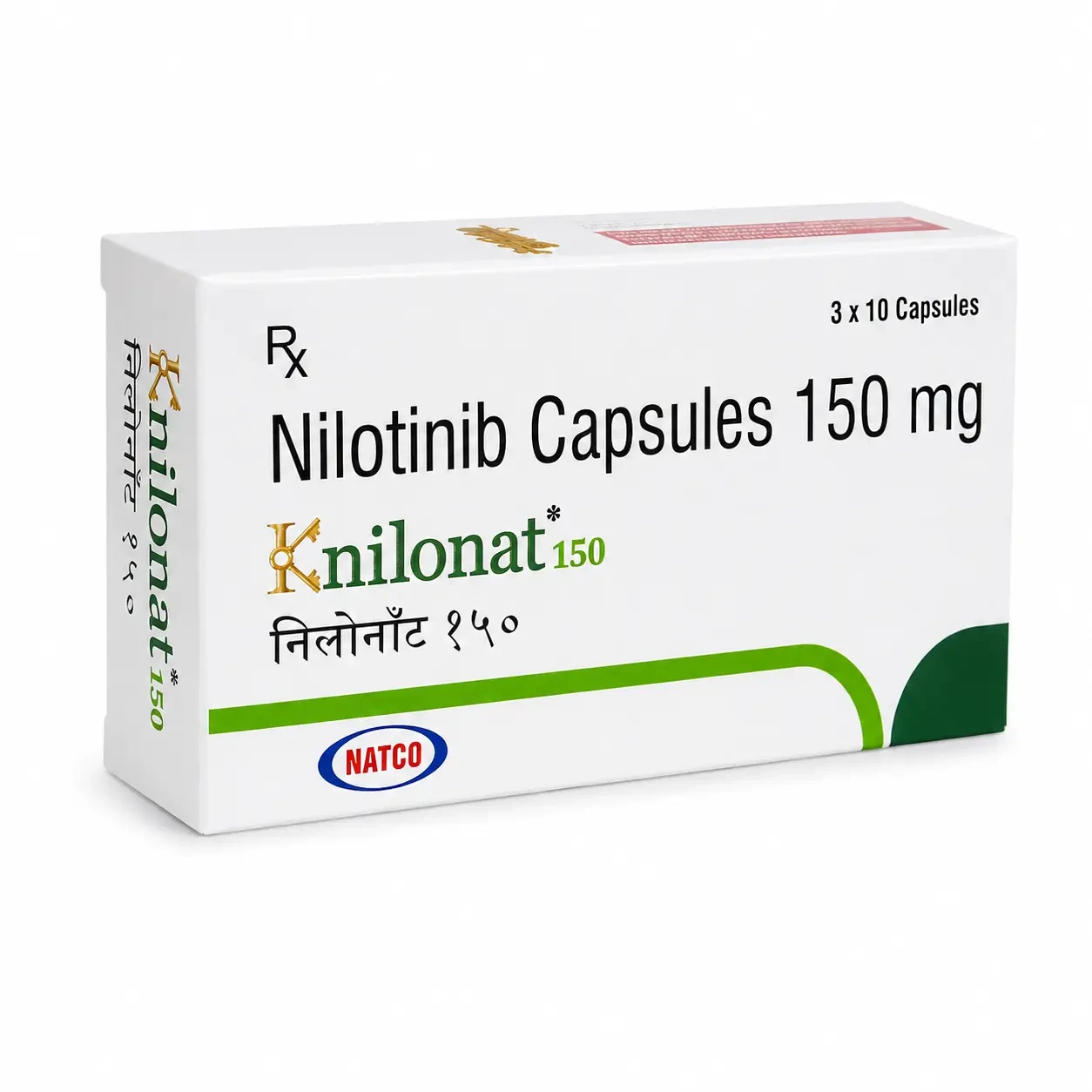
Knilonat 150 — Nilotinib 150 mg, 30 pcs, Natco
100% original product

Knilonat 150 — Nilotinib 150 mg Capsules, 30 Caps

8900 9700 -8% On order · from 15 days

Knilonat 150 is a potent antineoplastic pharmaceutical agent belonging to the class of protein tyrosine kinase inhibitors. The active pharmaceutical ingredient is Nilotinib at a strength of 150 mg per capsule. The medication is indicated for targeted therapy of Philadelphia chromosome-positive chronic myeloid leukemia (Ph+ CML). Knilonat 150 is manufactured by Natco Pharma Ltd., a renowned global pharmaceutical company operating in strict adherence to international GMP standards.

The mechanism of action of Knilonat 150 involves the selective inhibition of Bcr-Abl tyrosine kinase activity, which acts as the primary oncogenic driver in Ph+ CML cell proliferation. Nilotinib competitively blocks the ATP-binding site of the enzyme, shutting down downstream oncogenic signaling pathways and inducing apoptosis in leukemic cells. It exhibits superior potency and binding affinity compared to first-generation kinase inhibitors.

Key Advantages and Features of Knilonat 150:

  • High Targeted Potency: Selectively inhibits Bcr-Abl kinase to achieve rapid and deep molecular and cytogenetic responses.
  • Overcomes Resistance: Demonstrates activity against most mutated Bcr-Abl forms resistant to imatinib therapy.
  • Convenient Oral Therapy: Formulated as oral capsules, enabling effective outpatient management.
  • Disease Progression Control: Significantly reduces the risk of transformation to accelerated or blast phases of CML.
  • Natco Quality Assurance: Exceptional chemical purity, reliable bioavailability, and rigorous quality control manufacturing standards.

Knilonat 150 is supplied as hard capsules for oral administration. Each capsule contains Nilotinib equivalent to 150 mg of nilotinib base (as monohydrate hydrochloride). The capsule contents and shell are formulated with quality pharmaceutical excipients (including lactose monohydrate, crospovidone, poloxamer, magnesium stearate, colloidal silicon dioxide, gelatin, titanium dioxide, and colorants) to ensure physical stability and optimal drug dissolution.

The product is packaged in plastic bottles or blister strips sealed inside an outer Natco carton. The packaging includes anti-counterfeiting features, batch identification, manufacturing and expiration dates, and a comprehensive prescribing information insert.

Pharmacodynamics: Nilotinib is a selective Bcr-Abl tyrosine kinase inhibitor. It inhibits proliferation and induces apoptosis in Bcr-Abl expressing cell lines and primary Ph+ CML cells. Additionally, nilotinib inhibits KIT and PDGFR (platelet-derived growth factor receptor) kinase activities.

Pharmacokinetics: Peak plasma concentrations (Cmax) are reached approximately 3 hours after oral intake. High-fat meals significantly increase absorption and systemic exposure, requiring strict administration in a fasted state. Plasma protein binding is approximately 98%. Nilotinib is extensively metabolized in the liver mainly by the CYP3A4 enzyme. Elimination is primarily fecal (>90%). The terminal elimination half-life (T1/2) is approximately 17 hours.

Knilonat 150 is indicated for the treatment of:

  • • Adult patients with newly diagnosed Philadelphia chromosome-positive chronic myeloid leukemia (Ph+ CML) in chronic phase;
  • • Adult patients with Ph+ CML in chronic or accelerated phase with resistance or intolerance to prior therapy, including imatinib.

Treatment with Knilonat 150 must be managed by a hematologist or oncologist experienced in treating myeloproliferative disorders.

Method of Administration: Swallow capsules whole with water. Do not chew, open, or crush capsules.
Food Interaction: Knilonat 150 must be taken on an empty stomach. Do not eat food for at least 1 hour after or 2 hours before taking the dose.
Dosing Regimen: For newly diagnosed Ph+ CML in chronic phase, the recommended dose is 300 mg twice daily (two 150 mg capsules approximately 12 hours apart). For resistant/intolerant Ph+ CML, the dose may be increased to 400 mg twice daily.
Monitoring: Baseline and periodic ECGs (QT interval monitoring), liver function tests, serum lipase, blood glucose, and complete blood counts are required.

The use of Knilonat 150 is contraindicated in patients with:

  • • Known hypersensitivity to nilotinib or any capsule excipients;
  • • Long QT syndrome, uncorrected hypokalemia, hypomagnesemia, or severe bradycardia;
  • • Pregnancy and lactation;
  • • Pediatric patients under 18 years of age (safety and efficacy not established);
  • • Rare hereditary galactose intolerance, severe lactase deficiency, or glucose-galactose malabsorption.

Strong CYP3A4 Inhibitors (ketoconazole, itraconazole, clarithromycin, grapefruit juice): Substantially increase nilotinib plasma exposure and toxicity risk. Co-administration should be avoided.
Strong CYP3A4 Inducers (rifampin, carbamazepine, St. John's wort): Significantly decrease nilotinib plasma concentration and therapeutic efficacy.
QT-prolonging Drugs (antiarrhythmics, moxifloxacin): Increase the risk of fatal ventricular arrhythmias.
Proton Pump Inhibitors & Antacids: Alteration of gastric pH may reduce nilotinib bioavailability.

Knilonat 150 is contraindicated during pregnancy due to potential fetal harm, embryotoxicity, and teratogenicity. Females of reproductive potential must use highly effective contraception during therapy and for at least 2 weeks after the final dose.

It is unknown whether nilotinib is excreted in human milk. Breastfeeding must be discontinued during treatment with Knilonat 150.

Treatment with Knilonat 150 may cause the following adverse reactions:

  • Hematologic: Thrombocytopenia, neutropenia, anemia, febrile neutropenia.
  • Cardiovascular: QT interval prolongation, peripheral arterial occlusive disease, ischemic vascular events, hypertension.
  • Gastrointestinal & Metabolic: Nausea, constipation, diarrhea, elevated lipase/amylase, hyperglycemia, hypercalcemia.
  • Dermatologic: Rash, pruritus, alopecia, dry skin.
  • General Disorders: Headache, fatigue, myalgia, arthralgia, peripheral edema.

In cases of overdose with Knilonat 150, severe systemic adverse events may occur, including profound neutropenia, QT prolongation, cardiac arrhythmias, and hepatic dysfunction.

There is no specific antidote for nilotinib overdose. Treatment consists of immediate drug cessation, gastric lavage, activated charcoal administration, continuous ECG monitoring, and supportive symptomatic care.

Store Knilonat 150 in its original container below 30 °C, protected from light and moisture. Keep out of reach of children. The shelf life is 24 months (2 years) from the date of manufacture. Do not use past the expiry date. Prescription status: Prescription only (Rx-only).

To prevent product counterfeiting, Natco Pharma Ltd. incorporates several security features on Knilonat 150 packaging:

  • Security Hologram: High-definition 3D Natco hologram placed on the carton opening flap.
  • Corporate Branding: Official blue-and-red oval NATCO logo printed clearly on the package front.
  • Debossed Batch Data: Batch number, Manufacturing Date, and Expiration Date debossed on the carton flap and printed on the bottle/blister.
  • Verification QR Code: Dual-layer authentication sticker or QR code for online product verification on Natco’s official website.

Notice. The information on this page is for reference only and does not replace medical consultation. Always consult a healthcare professional and read the manufacturer's instructions before using any medicine. Self-medication may be dangerous. Information updated: 27.08.2026

Active ingredient
Dosage
150 mg
Dosage form Capsules
Capsules per pack 30
Packaging Blisters in a box
On order · from 15 days
100% original product
Delivery across Ukraine
1
Customer reviews

What Customers Say

No reviews yet

Your review can be the first!

Contact us

Choose a convenient way to contact

We work daily from 9:00 to 20:00